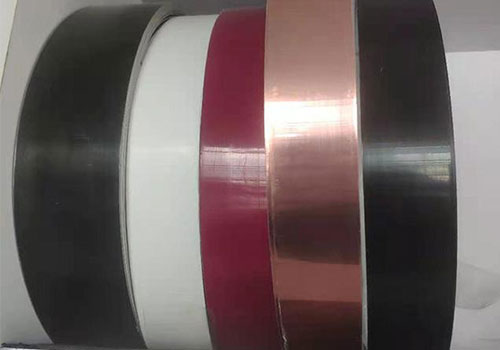
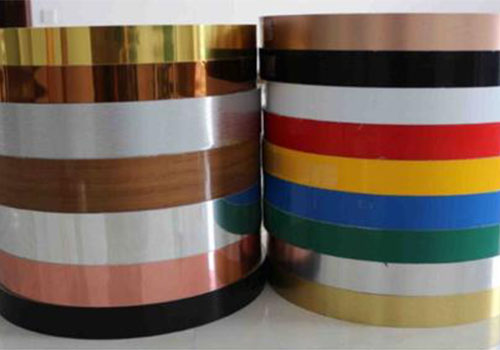
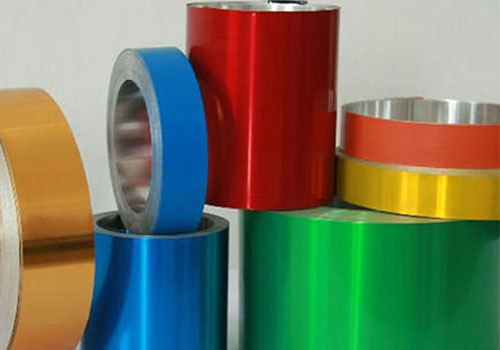
Roll Type Aluminum Strip Foil Pack
A Roll Type Aluminum Strip Foil Pack is a coiled aluminum product supplied in continuous strip form for high-efficiency processing, wrapping, stamping, insulation, cable shielding, and packaging operations. Compared with sheet material, roll-packed aluminum strip reduces handling time, supports automatic feeding equipment, and minimizes waste during slitting, forming, and lamination.
The material is normally produced from high-purity aluminum or aluminum alloy coil, precision rolled to the required thickness, slit to width, and tightly rewound onto paper, plastic, aluminum, or steel cores. Surface condition, coil tension, temper, edge quality, and packing protection can be adjusted for the end-use process.
Product Functions and Processing Benefits
Roll type aluminum strip foil packs are designed to deliver a stable, continuous material supply. Their coil structure is especially suitable for production lines using decoilers, stamping presses, roll-forming machines, laminators, and automatic wrapping systems.
| Function | Practical Value |
|---|---|
| Continuous feeding | Supports high-speed automated processing with fewer material changes |
| Lightweight barrier layer | Helps block light, moisture, vapor, grease, and contaminants when laminated or packaged correctly |
| Formability | Allows bending, embossing, folding, deep drawing, and profile shaping according to alloy temper |
| Heat and electrical conductivity | Suitable for thermal transfer parts, heat shields, transformer components, and cable applications |
| Corrosion resistance | Natural aluminum oxide film protects the surface in normal atmospheric environments |
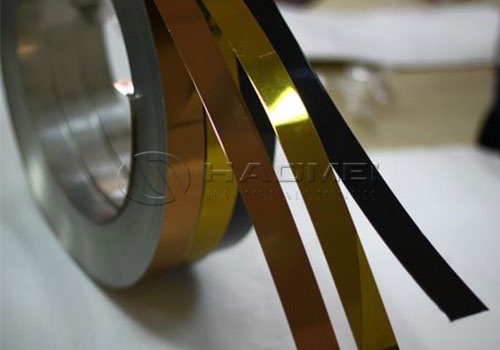
| Precise slitting | Narrow-width strips can be produced for fins, tags, closures, seals, and industrial components |
| Compact transportation | Coil packing reduces storage space and protects material during shipment |
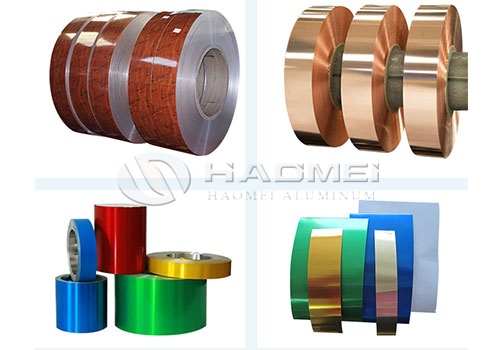
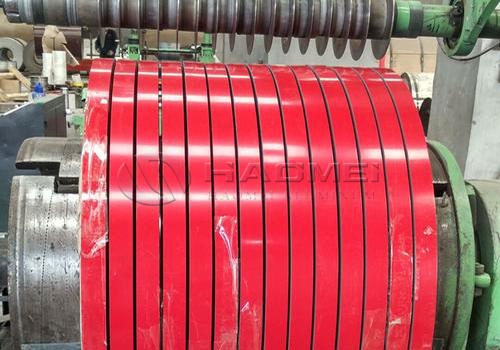
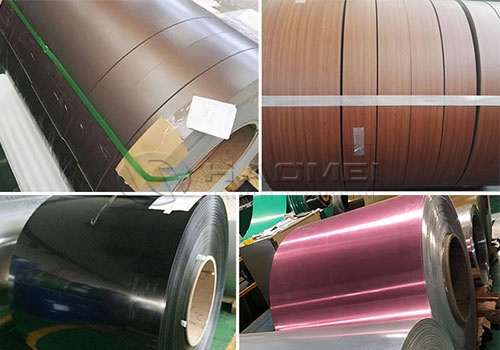
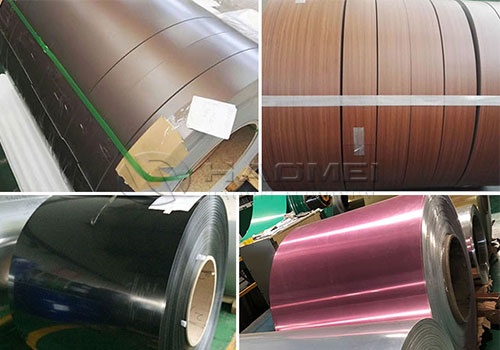
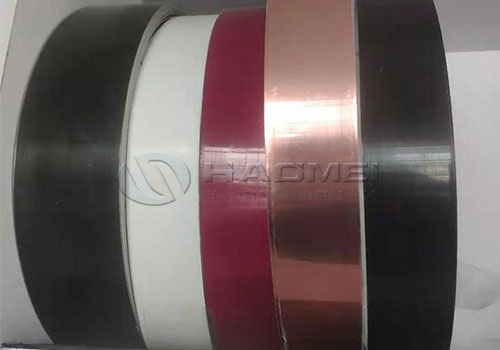
For decorative products, architectural trims, and branded packaging components, Color Coated Aluminum Strip can provide an additional painted surface with controlled color and gloss.
Common Applications
The combination of low weight, clean appearance, corrosion resistance, and controlled mechanical properties makes aluminum strip foil rolls useful across many industries.
| Industry | Typical Use of Roll Type Aluminum Strip Foil Pack |
|---|---|
| Flexible packaging | Foil laminate, food wrapping layers, pharmaceutical blister materials, sachets, and sealing structures |
| HVAC and refrigeration | Heat-exchanger fins, insulation facings, duct tape substrates, and thermal barriers |
| Electrical and cable | Cable shielding, transformer winding, capacitor foil, and electrical insulation laminates |
| Building and decoration | Ceiling trim, edge bands, insulation jackets, decorative profiles, and coated flashing materials |
| Automotive | Heat shields, insulation layers, reflective barriers, trim components, and stamped small parts |
| Household products | Disposable containers, foil lids, kitchen wraps, labels, and appliance insulation parts |
| Industrial fabrication | Stamping stock, gaskets, spacers, deep-drawn parts, and composite panel facings |
Typical Technical Specifications
Production dimensions are selected according to the converting machine, forming method, and final application. Tighter thickness and width tolerances are available for precision slitting and automated lines.
| Parameter | Standard Range | Custom Capability |
|---|---|---|
| Alloy | 1050, 1060, 1070, 1100, 3003, 3105, 5052, 8011 | Available by application requirement |
| Thickness | 0.020-0.200 mm for foil strip | 0.010-1.50 mm depending on alloy and rolling route |
| Width | 10-1,600 mm | Narrow slit widths and wide master coils available |
| Coil inner diameter | 150 mm, 152 mm, 200 mm, 300 mm, 405 mm, 508 mm | Custom cores available |
| Coil outer diameter | Up to 1,800 mm | Determined by weight and transport limits |
| Coil weight | 50-5,000 kg | Available according to handling equipment |
| Surface | Mill finish, bright, embossed, coated, laminated, oiled, dry | Surface treatment matched to end use |
| Edge condition | Mill edge, slit edge, deburred edge | Controlled burr direction available |
| Flatness | Suitable for rewinding and conversion | Enhanced flatness for stamping or lamination |
Alloy Grades and Temper Conditions
Alloy selection affects strength, elongation, corrosion behavior, and forming response. Pure aluminum grades are preferred for conductivity and deep drawing, while manganese or magnesium-containing alloys offer higher strength.
| Alloy | Typical Temper | Main Characteristics | Suitable Uses |
|---|---|---|---|
| 1050 | O, H14, H18, H24 | High aluminum purity, excellent formability and conductivity | Packaging, electrical strip, reflectors |
| 1060 | O, H14, H18, H24 | Good corrosion resistance and ductility | Insulation, cable foil, decorative strips |
| 1070 | O, H14, H18 | Very high conductivity and softness in O temper | Electrical and chemical equipment components |
| 1100 | O, H14, H18, H24 | Good workability with slightly higher strength than pure grades | Fin stock, packaging, general fabrication |
| 3003 | O, H14, H16, H18, H24 | Manganese-enhanced strength and corrosion resistance | Roofing, heat shields, containers |
| 3105 | H14, H16, H18, H24 | Moderate strength and good coating performance | Painted trim and building materials |
| 5052 | H32, H34 | Stronger, magnesium-bearing, marine-grade corrosion resistance | Industrial parts, automotive shields |
| 8011 | O, H14, H18 | Widely used foil alloy with reliable rolling performance | Household foil, packaging foil, closures |
The O temper indicates annealed, soft material with excellent bending and drawing behavior. H14 and H24 tempers provide semi-hard strength for general fabrication, while H18 is hard temper and commonly selected when higher rigidity is needed. Temper choice should match the forming radius, press load, and required final stiffness.
Chemical Composition Reference
The chemical composition of aluminum strip foil follows the alloy standard agreed for the order. Values shown are typical maximum or nominal limits in percent by mass.
| Alloy | Si | Fe | Cu | Mn | Mg | Zn | Ti | Al |
|---|---|---|---|---|---|---|---|---|
| 1050 | 0.25 | 0.40 | 0.05 | 0.05 | 0.05 | 0.07 | 0.05 | 99.50 min |
| 1060 | 0.25 | 0.35 | 0.05 | 0.03 | 0.03 | 0.05 | 0.03 | 99.60 min |
| 1100 | Si + Fe 0.95 max | - | 0.05-0.20 | 0.05 max | - | 0.10 max | - | 99.00 min |
| 3003 | 0.60 max | 0.70 max | 0.05-0.20 | 1.0-1.5 | - | 0.10 max | - | Balance |
| 5052 | 0.25 max | 0.40 max | 0.10 max | 0.10 max | 2.2-2.8 | 0.10 max | - | Balance |
| 8011 | 0.90 max | 1.00 max | 0.10 max | 0.20 max | 0.05 max | 0.10 max | 0.08 max | Balance |
Mechanical and Physical Properties
Mechanical values vary by thickness, temper, test direction, and governing standard. The table provides practical reference values for common strip coil selections.
| Alloy and Temper | Tensile Strength, MPa | Yield Strength, MPa | Elongation, % | Density, g/cm³ |
|---|---|---|---|---|
| 1050-O | 60-95 | 20 min | 20 min | 2.70 |
| 1050-H14 | 85-125 | 65 min | 3 min | 2.70 |
| 1100-H14 | 95-135 | 75 min | 3 min | 2.71 |
| 3003-O | 95-130 | 35 min | 20 min | 2.73 |
| 3003-H14 | 120-160 | 115 min | 3 min | 2.73 |
| 5052-H32 | 195-245 | 130 min | 10 min | 2.68 |
| 8011-H18 | 125-165 | 110 min | 1 min | 2.71 |
Aluminum also provides a melting range near 600-660°C depending on alloy, thermal conductivity typically around 120-235 W/m·K, and electrical conductivity that is especially high in 1050, 1060, and 1070 grades.
Implementation Standards and Quality Controls
Roll type aluminum strip foil packs can be manufactured in accordance with international specifications or customer technical agreements.
| Standard | Scope |
|---|---|
| ASTM B209 | Aluminum and aluminum-alloy sheet and plate, commonly referenced for strip coil requirements |
| EN 485 | Aluminum and aluminum alloys for sheet, strip, and plate mechanical properties and tolerances |
| EN 573 | Chemical composition and designation system for wrought aluminum alloys |
| GB/T 3880 | Chinese standard for aluminum and aluminum alloy sheets and strips |
| JIS H4000 | Japanese standard for aluminum and aluminum alloy sheet, strip, and plate |
| ASTM B479 | Annealed aluminum and aluminum-alloy foil for flexible barrier and packaging applications |
Quality inspection may include thickness measurement, width verification, coil weight confirmation, surface examination, pinhole inspection for foil grades, tensile testing, chemical analysis, burr checking, and packaging integrity review.
Roll Packing and Storage Requirements
A dependable foil pack protects the coil from moisture, dust, deformation, and surface abrasion. Standard packing commonly combines an inner protective wrap, moisture barrier paper, plastic film, corner protection, wooden pallet support, and steel or plastic strapping.
| Packing Element | Protection Function |
|---|---|
| Core plug or core cap | Prevents damage to the inner coil diameter |
| Moisture-proof paper | Reduces water vapor exposure during transport |
| Plastic film | Shields against dust and handling contamination |
| Edge protector | Reduces risk of telescoping and edge dents |
| Wooden pallet or crate | Supports safe forklift and container handling |
| Strapping | Stabilizes the coil during storage and shipment |
Store aluminum strip foil rolls in a dry, ventilated warehouse away from corrosive chemicals and direct water exposure. Coils should remain on pallets or supported racks rather than placed directly on concrete floors. For coated or laminated material, avoid excessive heat and pressure that may affect the surface finish or bonding layer.
A properly specified Roll Type Aluminum Strip Foil Pack gives converters and manufacturers a clean, stable, and process-ready aluminum material for demanding production environments.