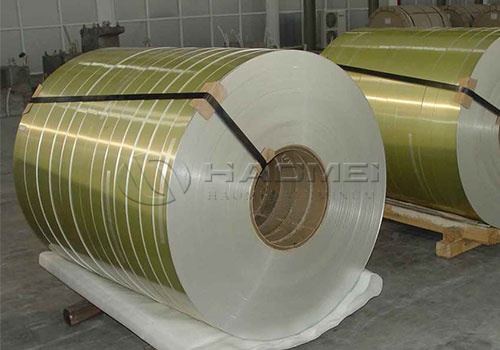
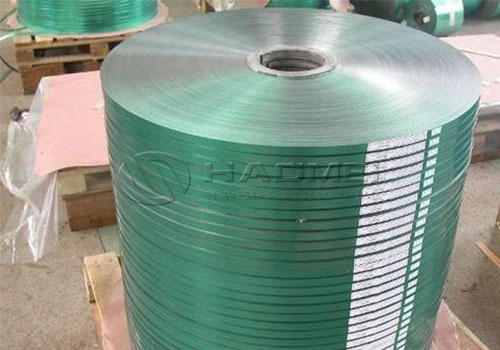
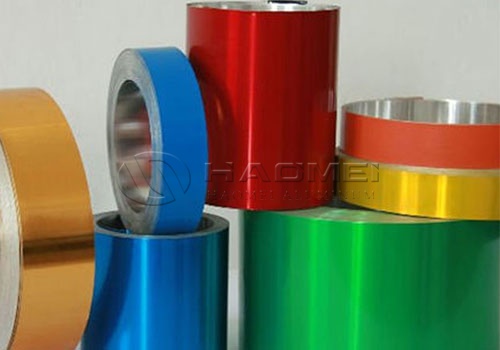
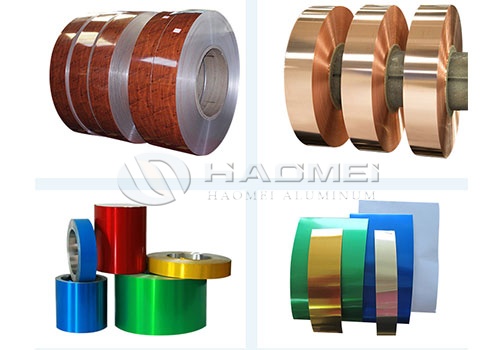
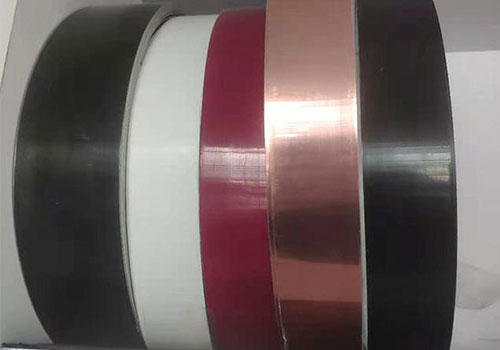
Coated Aluminium Strip for Channel Letter
Coated Aluminium Strip for Channel Letter: The Material That Defines the Sign's Edge
A channel letter is often judged by its illuminated face, but its long-term visual quality is largely determined by the return, the narrow sidewall that gives the letter depth. Coated aluminium strip for channel letter fabrication is designed specifically for this demanding role. It forms the curved perimeter of illuminated letters, creates a clean colored edge, supports the acrylic face, and protects the structure from rain, sunlight, dust, and repeated temperature changes.
Rather than treating the strip as a simple metal coil, fabricators should view it as the architectural skin of a sign. Its alloy controls bending behavior, its temper controls how cleanly it forms, and its coating system decides whether a logo remains crisp after years of outdoor exposure. A well-selected strip reduces cracking at sharp curves, minimizes color variation between letters, and makes automated channel-letter bending more stable.
Why the return strip matters in channel letter production
The coated aluminium strip serves as the sidewall of front-lit, reverse-lit, halo-lit, and combination channel letters. During production, the strip is fed through a bending machine or manually formed around the letter profile. It is then fixed to the letter backplate, while the front face is usually acrylic, polycarbonate, or another translucent material.
This material has several practical functions. It gives the letter its depth, usually from 30 mm to 150 mm or more. It creates a finished visible color around the sign edge. It helps keep the letter body rigid without making the sign excessively heavy. It also provides a weather-resistant barrier around internal LED modules, wiring, and power connections.
For small lettering, narrow strokes, and complex fonts, formability becomes especially important. A strip that is too hard can kink or crack at tight radii. A strip that is too soft may lose straightness and make it harder to maintain accurate letter geometry. This is why 3003 alloy in H14 or H24 temper is widely specified for channel letter returns: it balances controlled strength with reliable bending.
Typical technical parameters
| Parameter | Common range for channel letter strip |
|---|---|
| Alloy | AA 3003, AA 3004, AA 3105 |
| Temper | H14, H24, H16, H26, O temper for demanding curves |
| Thickness | 0.30 mm to 1.20 mm |
| Standard thicknesses | 0.50 mm, 0.60 mm, 0.70 mm, 0.80 mm, 1.00 mm |
| Width | 20 mm to 300 mm |
| Common widths | 50 mm, 60 mm, 75 mm, 100 mm, 120 mm |
| Coil inner diameter | 150 mm, 300 mm, 405 mm, or customized |
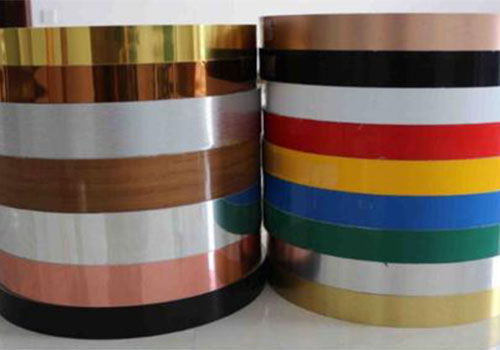
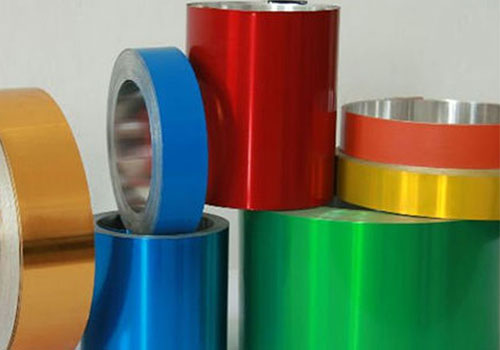
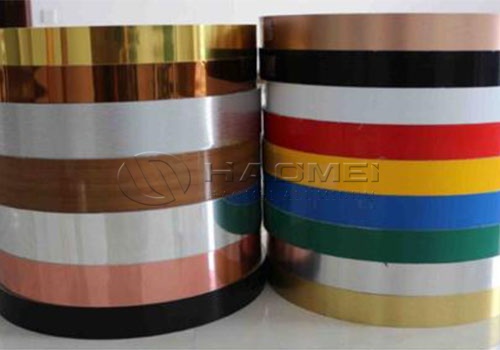
| Surface finish | PE coated, PVDF coated, polyester coated, brushed, gloss, matte |
| Coating thickness | Generally 15 to 25 μm for PE; 25 to 35 μm or more for PVDF |
| Color options | RAL colors, Pantone references, custom matched colors |
Thickness should follow the letter size and installation environment. A 0.5 mm to 0.6 mm strip is often suitable for indoor signs and smaller letters. Outdoor letters with deeper returns, broad spans, or exposed locations commonly use 0.7 mm to 1.0 mm material. Thicker strip improves dent resistance and structural stability, although it requires greater bending force.
Alloy and tempering conditions
AA 3003 is a manganese-containing aluminium alloy valued for corrosion resistance and moderate strength. It is more robust than commercially pure 1100 aluminium while remaining easy to process. For channel letters, it provides consistent machine feeding, controlled springback, and good resistance to everyday urban atmospheres.
H14 temper is half-hard, making it a popular option for standard channel letter machines and general outdoor signage. H24 has similar strength characteristics after thermal treatment and can be selected where production procedures call for it. H16 or H26 provides greater stiffness for larger letters and straight returns, but it is less suited to extremely tight bends. O temper, meaning annealed material, offers maximum ductility and is useful for artistic scripts, narrow curves, and highly detailed logos.
| Alloy | Main benefit in channel letters | Recommended use |
|---|---|---|
| 3003 | Good formability, corrosion resistance, stable strength | General illuminated channel letters |
| 3004 | Higher strength than 3003 | Large outdoor letters and deeper returns |
| 3105 | Good coating compatibility and forming performance | Painted decorative sign returns |
| 1100 | Very high ductility | Simple indoor letters and demanding curves |
Chemical composition of AA 3003 aluminium strip
The chemistry of 3003 alloy is controlled to create dependable forming characteristics while preserving corrosion resistance. Values are shown as weight percentages.
| Element | Chemical content, % |
|---|---|
| Aluminium, Al | Balance |
| Manganese, Mn | 1.00-1.50 |
| Copper, Cu | 0.05-0.20 |
| Iron, Fe | 0.70 max |
| Silicon, Si | 0.60 max |
| Zinc, Zn | 0.10 max |
| Other elements, each | 0.05 max |
| Other elements, total | 0.15 max |
Manganese is the principal strengthening addition. It gives 3003 strip better resistance to denting and deformation than pure aluminium, without sacrificing the bendability needed for letter forming. Copper is kept at a low level to support strength while maintaining useful corrosion behavior.
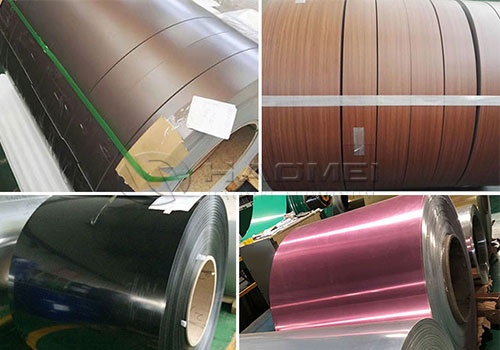
Coating systems: color is also protection
The painted surface of a channel letter strip does more than provide brand color. It shields the aluminium from moisture, contaminants, ultraviolet radiation, and surface staining. The coating should remain firmly bonded during bending, riveting, gluing, and handling.
For interior signage or short-to-medium outdoor service, polyester or PE Coated Aluminum Strip offers bright color, economical processing, and good flexibility. PE finishes are available in high-gloss, semi-gloss, matte, textured, and metallic appearances. Their flexibility helps prevent film damage around curves and folded corners.
For coastal areas, strong sunlight, industrial districts, and premium architectural signs, PVDF Coated Aluminum Strip offers stronger resistance to fading, chalking, and aggressive weather. A PVDF coating system is especially valuable for corporate signage where color consistency must be maintained for many years.
Before fabrication, the surface is commonly protected by a removable PE film. This film reduces scratches during coil slitting, bending, transport, and assembly. It should be removed after installation rather than left exposed for extended periods, as heat and sunlight can make removal more difficult.
Implementation standards and inspection points
Channel letter strip is commonly produced with reference to ASTM B209 for aluminium and aluminium-alloy sheet and strip, EN 485 for tolerances and mechanical properties, and GB/T 3880 for aluminium sheet and strip requirements. Coating performance may be evaluated through standards such as ASTM D3359 for adhesion, ASTM D2794 for impact resistance, ASTM B117 for salt spray exposure, and ASTM G154 for accelerated UV weathering.
In daily purchasing and fabrication, the most useful inspection points are thickness tolerance, width tolerance, coil edge quality, paint adhesion, coating uniformity, color difference, bend performance, and surface cleanliness. Burr-free slit edges protect workers and avoid tearing protective film. Flat, evenly wound coils support smooth feeding through automatic channel letter bending equipment.
A practical test is to bend a sample around a small radius appropriate to the intended letter profile. The coating should not visibly crack, peel, or whiten excessively. The strip should retain a smooth edge without severe wrinkling. This simple action connects laboratory specifications with the reality of sign-shop production.
Selecting the right strip for the finished sign
A successful channel letter begins with matching the strip to the application. Fine script fonts benefit from thinner 3003-O or H14 strip with flexible PE paint. Large exterior letters usually need 3003-H14, 3004-H14, or similar material in 0.7 mm to 1.0 mm thickness. Coastal, rooftop, and sun-intense installations gain additional security from PVDF color coating.
Color should be evaluated under the lighting conditions where the sign will operate. A glossy red can appear vivid in daylight yet reflect nearby lights at night. Matte black creates a refined edge with reduced glare. Brushed silver and metallic gold finishes can make a letter body look more architectural, but they require careful coil direction control so the grain remains consistent across every letter.
Coated aluminium strip for channel letter production is therefore a functional design material, not merely a painted metal band. With a suitable alloy, temper, thickness, coating, and tolerance control, it helps sign makers create letters that form accurately, illuminate cleanly, and keep their intended color through years of service.