Color Aluminum Strip Coils for Decoration
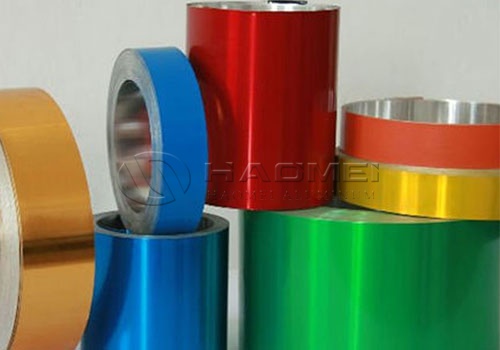
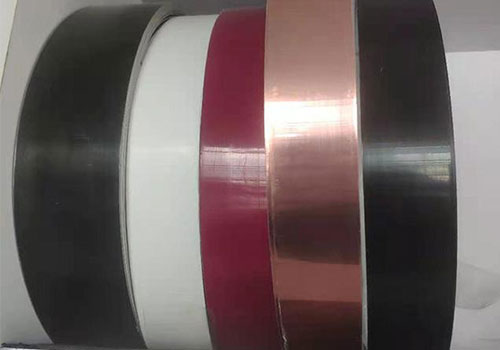
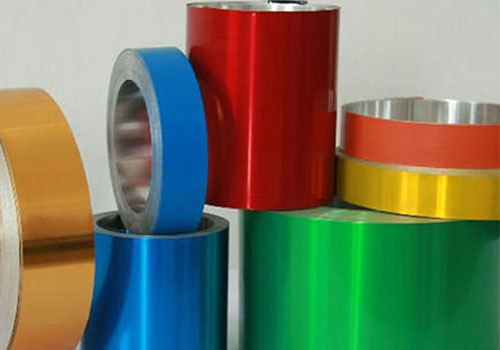
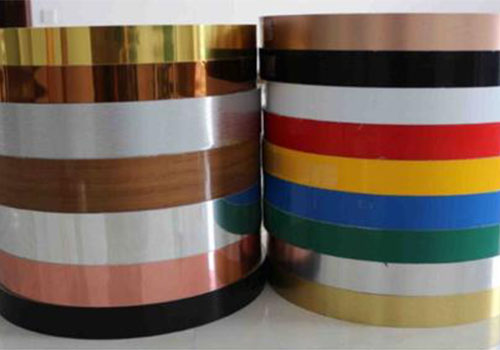
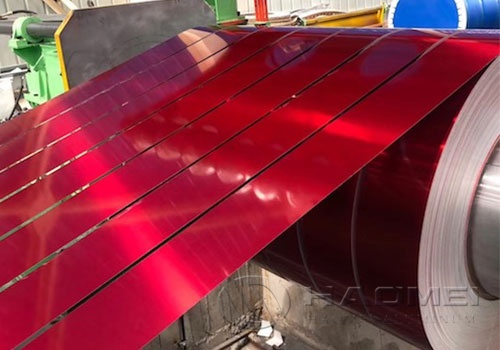
Color aluminum strip coils for decoration are pre-painted, slit aluminum coils designed for visible architectural and interior parts where appearance, formability, and durability must work together. The strip combines a lightweight aluminum base with a controlled coating system, offering stable color, smooth edges, corrosion resistance, and efficient downstream processing.
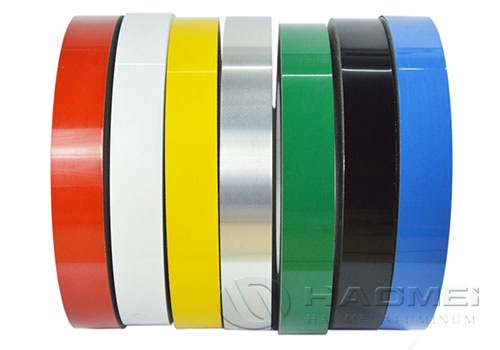
Compared with post-painted metal parts, pre-coated aluminum strip reduces fabrication time, improves coating consistency, and supports continuous production for trims, ceilings, signage, channel letters, lighting components, decorative profiles, and panel edging. For buyers who need finished material ready for bending, punching, roll forming, and laminating, Color Coated Aluminum Strip is a practical material choice.
What the Product Does
Color aluminum strip coils are mainly used to add decorative value while protecting the aluminum substrate. The coating layer blocks moisture, industrial air, mild chemicals, and ultraviolet exposure depending on paint type. The aluminum core contributes low weight, ductility, thermal conductivity, and natural oxidation resistance.
| Function | Customer Benefit | Common Result |
|---|---|---|
| Decorative color finish | Consistent surface for visible parts | Better brand and design matching |
| Corrosion protection | Longer service life in indoor and outdoor areas | Lower maintenance cost |
| Lightweight structure | Easier installation and transport | Reduced load on frames and ceilings |
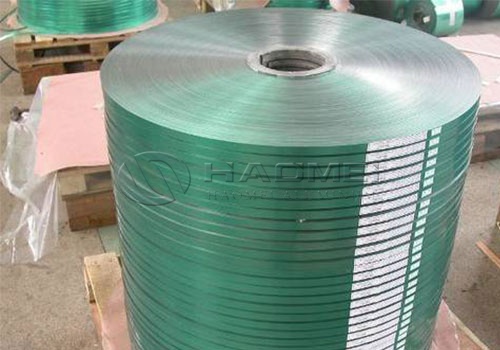
| Slit coil supply | Suitable for automated forming lines | Less scrap and faster production |
| Formable temper selection | Bending, stamping, and roll forming | Fewer cracks at edges and bends |
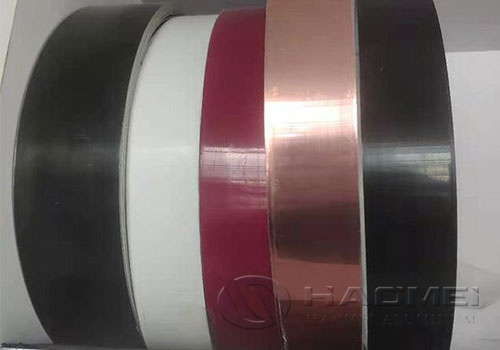
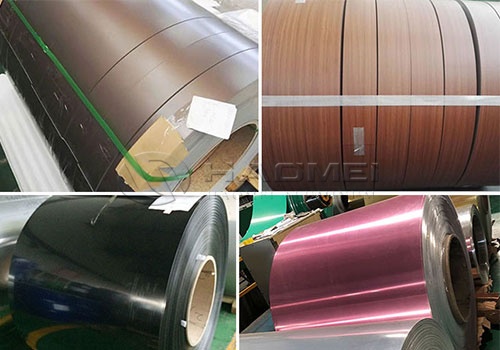
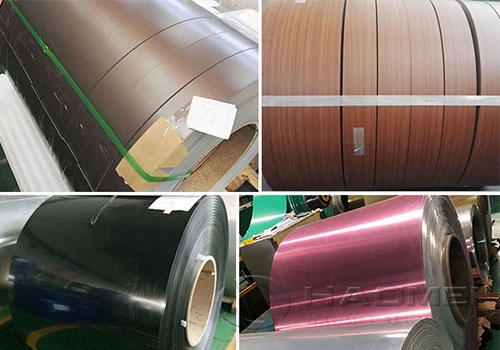
| Coating customization | Gloss, texture, wood grain, metallic finish | Wider design freedom |
Decorative Applications
Color aluminum strip coils are widely used where a narrow, clean, and durable metal surface is required. The strip can be supplied in small or large coils for automatic feeding, helping manufacturers keep stable productivity.
| Application Area | Typical Parts | Recommended Coating |
|---|---|---|
| Interior decoration | Ceiling strips, wall trims, partitions, skirting | PE, HDP |
| Exterior building trim | Facade edging, louvers, sunshade parts | PVDF, HDP |
| Signage and advertising | Channel letters, sign frames, display borders | PE, PVDF |
| Lighting industry | Lamp housings, reflective decorative rings | PE, polyester matte |
| Furniture and appliances | Door edging, cabinet strips, panel borders | PE, SMP |
| Transportation interiors | Vehicle trim, luggage rack decoration | HDP, PVDF |
| Rainwater and roof accessories | Gutter strips, flashing, fascia trim | PVDF, SMP |
Main Technical Specifications
The final specification depends on alloy, temper, coil width, coating structure, color, surface finish, and packing method. Tight tolerance control is especially important for decorative strip because poor width accuracy can affect assembly gaps and visible alignment.
| Item | Standard Range | Custom Options |
|---|---|---|
| Thickness | 0.20-3.00 mm | Thicker or thinner by project |
| Width | 10-1600 mm | Precision slitting available |
| Coil inner diameter | 150 mm, 300 mm, 405 mm, 508 mm | As line requirement |
| Coil outer diameter | 800-1500 mm | Limited by weight and packing |
| Coil weight | 0.5-5.0 tons | Small coils for manual handling |
| Width tolerance | ±0.05-±0.30 mm | Based on width and thickness |
| Thickness tolerance | According to EN, ASTM, GB | Tight control on request |
| Paint thickness, front | 12-35 µm | PVDF up to 35 µm or more |
| Paint thickness, back | 5-15 µm | Service coating or primer |
| Gloss | 10-90 GU | Matte, satin, high gloss |
| Color system | RAL, Pantone, custom sample | Wood grain, stone pattern, metallic |
| Surface | Smooth, embossed, brushed effect | Protective film optional |
Alloy and Temper Selection
Different decorative products need different levels of softness, strength, and edge quality. Pure aluminum grades offer excellent formability and bright surface quality, while 3000 and 5000 series alloys provide higher strength and better resistance in demanding environments.
| Alloy | Temper | Main Feature | Typical Decorative Use |
|---|---|---|---|
| 1050 | O, H12, H14, H24 | Very high formability, high aluminum content | Soft trims, labels, light decoration |
| 1060 | O, H14, H24 | Good surface quality and easy bending | Interior strips, lamp parts, signs |
| 1100 | O, H14, H16 | Good ductility and corrosion resistance | Decorative edging, panel accessories |
| 3003 | O, H14, H24 | Balanced strength and formability | Ceiling strips, roll formed profiles |
| 3004 | H24, H26 | Higher strength than 3003 | Exterior trim, painted building parts |
| 3105 | H14, H24, H26 | Good paint adhesion and weathering base | Facade trim, gutters, roofing accessories |
| 5052 | O, H32, H34 | Higher strength and marine resistance | Premium outdoor decoration, transport trim |
Chemical Composition Reference
The values shown are typical maximum or range values by mass percent. Exact limits should be confirmed by purchase standard and mill certificate.
| Alloy | Si | Fe | Cu | Mn | Mg | Cr | Zn | Al |
|---|---|---|---|---|---|---|---|---|
| 1050 | 0.25 | 0.40 | 0.05 | 0.05 | 0.05 | - | 0.05 | ≥99.50 |
| 1060 | 0.25 | 0.35 | 0.05 | 0.03 | 0.03 | - | 0.05 | ≥99.60 |
| 1100 | Si+Fe 0.95 | Si+Fe 0.95 | 0.05-0.20 | 0.05 | - | - | 0.10 | ≥99.00 |
| 3003 | 0.60 | 0.70 | 0.05-0.20 | 1.00-1.50 | - | - | 0.10 | Balance |
| 3004 | 0.30 | 0.70 | 0.25 | 1.00-1.50 | 0.80-1.30 | - | 0.25 | Balance |
| 3105 | 0.60 | 0.70 | 0.30 | 0.30-0.80 | 0.20-0.80 | 0.20 | 0.40 | Balance |
| 5052 | 0.25 | 0.40 | 0.10 | 0.10 | 2.20-2.80 | 0.15-0.35 | 0.10 | Balance |
Mechanical Property Guide
Mechanical values vary with thickness and temper. For parts requiring tight bending, softer tempers such as O, H12, or H24 are usually preferred. For straight decorative profiles, H14, H16, H24, and H26 can offer better shape stability.
| Alloy Temper | Tensile Strength MPa | Yield Strength MPa | Elongation % | Forming Character |
|---|---|---|---|---|
| 1050 O | 60-100 | 20-50 | 25-35 | Excellent deep forming |
| 1060 H24 | 95-135 | 70-110 | 6-12 | Good bending and slitting |
| 1100 H14 | 110-145 | 95-125 | 5-10 | Stable for trims |
| 3003 H24 | 140-180 | 115-160 | 4-10 | Good roll forming |
| 3105 H26 | 175-215 | 150-190 | 3-8 | Rigid decorative profiles |
| 5052 H32 | 210-260 | 160-215 | 6-12 | Strong outdoor parts |
Coating Systems and Performance
Paint selection has a direct effect on color retention, bending resistance, and outdoor life. PE coatings are economical for interior and general decoration. PVDF coatings are recommended for long-term exterior exposure because of stronger UV and chalking resistance.
| Coating Type | Resin Base | Weather Resistance | Typical Film Thickness | Best Fit |
|---|---|---|---|---|
| PE | Polyester | Good for indoor and mild outdoor use | 12-25 µm | Ceilings, signs, appliance trim |
| HDP | High-durability polyester | Better UV and aging resistance | 18-30 µm | Exterior decorative profiles |
| SMP | Silicone modified polyester | Good hardness and color retention | 18-30 µm | Roofing trim, fascia, gutters |
| PVDF | Fluorocarbon | Excellent outdoor weathering | 25-35 µm | Facades, premium exterior decoration |
Quality Tests and Implementation Standards
Reliable color aluminum strip coils require control from aluminum substrate to chemical pretreatment, primer, topcoat curing, slitting, and packing. The standards used may vary by region, but the following are commonly referenced in international supply.
| Standard | Scope |
|---|---|
| ASTM B209 | Aluminum and aluminum alloy sheet and plate |
| EN 485 | Aluminum sheet, strip, and plate tolerances and properties |
| EN 573 | Chemical composition of aluminum alloys |
| EN 515 | Temper designations for wrought aluminum |
| GB/T 3880 | Aluminum and aluminum alloy plates, sheets, and strips |
| GB/T 17748 | Painted aluminum and aluminum alloy sheets and strips |
| AAMA 2603 | Performance for organic coatings, general exterior use |
| AAMA 2604 | High-performance exterior coating requirements |
| AAMA 2605 | Superior-performance fluoropolymer coating requirements |
| ISO 2409 | Cross-cut adhesion test |
| ASTM D2794 | Impact resistance test |
| ASTM B117 | Salt spray corrosion test |
| ASTM G154 | UV exposure test |
| Test Item | Common Requirement | Test Meaning |
|---|---|---|
| Pencil hardness | ≥HB or ≥H | Surface scratch resistance |
| T-bend | ≤2T-3T | Coating flexibility during bending |
| Impact resistance | 50 kg.cm, no cracking | Resistance to forming shock |
| Adhesion | Grade 0-1 | Coating bonding strength |
| Salt spray | 500-1000 h or project based | Corrosion resistance |
| Color difference | ΔE ≤1.5 or agreed sample | Batch-to-batch color control |
| Solvent resistance | ≥100 MEK rubs for some coatings | Curing and coating density |
Manufacturing and Surface Control
Production usually starts with degreasing and chemical pretreatment to improve paint bonding. A primer is applied first, followed by a topcoat and controlled oven curing. After cooling, the coil is slit into the requested width. Edge burr, camber, telescoping, and surface scratches are monitored because these factors affect decoration quality and automatic feeding.
For high-end visible surfaces, protective film can be added to reduce handling marks during cutting, bending, or installation. Packing normally includes moisture-proof paper, plastic film, edge protectors, steel or wooden pallets, and eye-to-wall or eye-to-sky coil orientation.
Purchasing Notes
Before ordering, customers should confirm alloy, temper, thickness, width, color sample, coating type, gloss, film thickness, coil weight, inner diameter, tolerance, and application environment. Outdoor decorative projects should consider UV level, coastal humidity, industrial pollution, and expected service life. Interior projects may focus more on color effect, bending ability, cost control, and delivery speed.
Color aluminum strip coils for decoration offer a strong balance of appearance, processing efficiency, and long-term protection. With the right alloy, temper, coating system, and quality standard, the material can help manufacturers produce attractive decorative components with stable performance and repeatable production results.