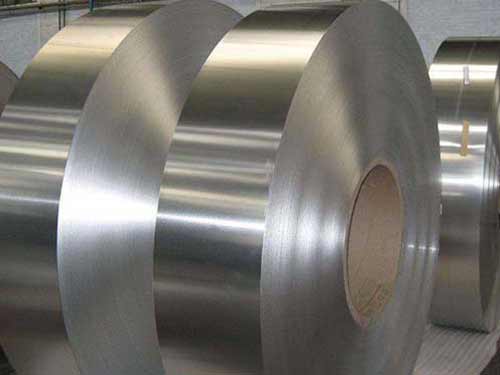
Alloy 4004 3003 4004 Strip Aluminum Plate for Car
4004/3003/4004 aluminum strip plate is a clad brazing material engineered for car heat-management systems. It combines a strong 3003 aluminum alloy core with 4004 aluminum brazing layers on both sides. During controlled-atmosphere brazing, the 4004 cladding melts first and creates durable joints, while the 3003 core retains the shape and mechanical support required by the finished component.
This three-layer construction is widely used where low weight, rapid heat transfer, corrosion resistance, and reliable mass production are needed. Typical automotive parts include radiator tubes, condenser components, charge-air coolers, heater cores, evaporator structures, oil coolers, battery cooling plates, and other brazed aluminum assemblies.
Material Structure and Working Principle
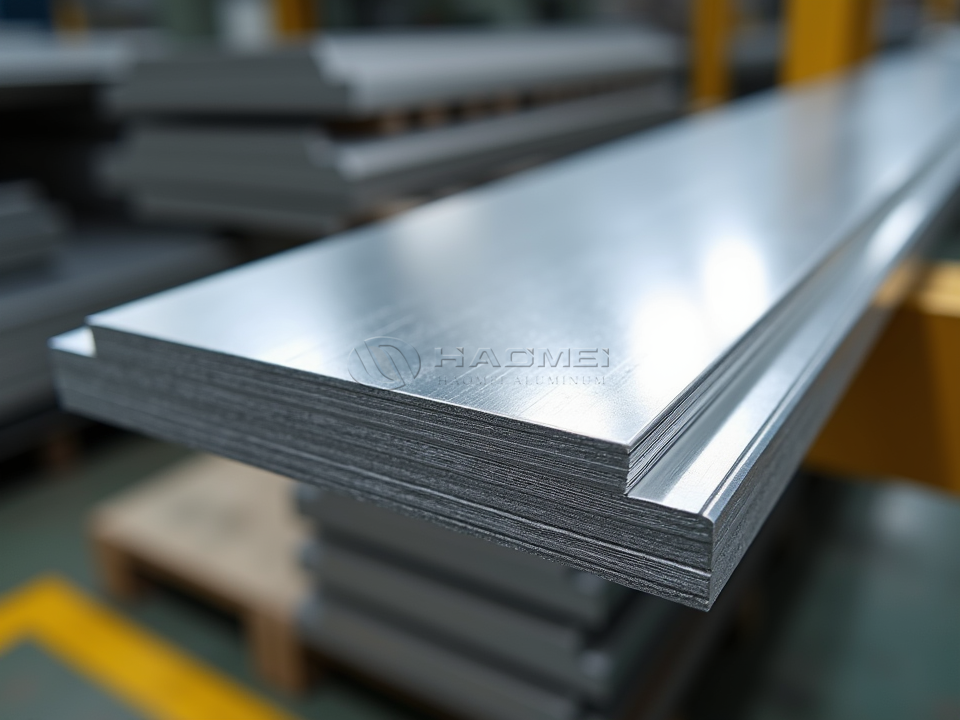
The designation 4004/3003/4004 describes a sandwich-style clad product. The central 3003 layer provides formability and strength. The outer 4004 layers contain a high silicon content, which reduces their melting range. When the assembly enters a brazing furnace, the clad surfaces form molten filler metal and flow into the designed joint gaps through capillary action.
After cooling, the brazed seam becomes a metallurgical connection with good thermal conductivity and vibration resistance. Double-sided cladding supports brazing on either face, helping manufacturers produce compact multi-channel heat exchangers with fewer joining operations.
| Layer | Typical Function | Main Advantage |
|---|---|---|
| 4004 upper cladding | Brazing filler metal | Low melting range and good filler flow |
| 3003 core | Structural carrier | Formability, moderate strength, corrosion resistance |
| 4004 lower cladding | Brazing filler metal | Enables joining on the reverse side |
The cladding ratio can be selected according to joint design, required filler volume, part geometry, and furnace brazing cycle. A common total cladding proportion is approximately 10% to 20%, divided between both surfaces, although customized ratios are available for demanding applications.
Why 4004/3003/4004 Is Suited to Car Components
Automotive thermal systems operate under pressure cycling, temperature variation, road vibration, humidity, and exposure to coolant or condensate. A properly selected clad strip helps balance production efficiency with service durability.
| Performance Area | Contribution of 4004/3003/4004 Clad Strip |
|---|---|
| Brazing behavior | 4004 cladding melts before the 3003 core and forms consistent joints |
| Heat transfer | Aluminum construction supports efficient thermal exchange |
| Lightweight design | Lower density than steel supports vehicle mass reduction |
| Forming capability | 3003 core can be roll formed, stamped, corrugated, and folded |
| Joint coverage | Double-sided cladding is suitable for complex brazed assemblies |
| Production consistency | Coil material supports continuous stamping and tube-forming lines |
| Corrosion performance | Aluminum naturally forms an oxide film; further protection can be engineered through coatings and system design |
For projects requiring a monolithic core alloy in related stamped automotive parts, 3003 Aluminum Strip is also a practical choice where brazing cladding is not required.
Chemical Composition
The chemical composition is controlled to create a clear melting-temperature difference between the 4004 cladding and 3003 core. Values shown are typical maximum or specified ranges in percent by mass. Requirements should be confirmed against the purchase specification and applicable standard.
| Alloy | Si | Fe | Cu | Mn | Mg | Zn | Ti | Other Elements | Al |
|---|---|---|---|---|---|---|---|---|---|
| 4004 cladding | 9.0-10.5 | 0.80 max | 0.25 max | 0.10 max | 1.0-2.0 | 0.20 max | 0.20 max | 0.05 each, 0.15 total max | Balance |
| 3003 core | 0.60 max | 0.70 max | 0.05-0.20 | 1.0-1.5 | 0.10 max | 0.10 max | - | 0.05 each, 0.15 total max | Balance |
The high silicon level in 4004 is central to its role as a brazing alloy. Magnesium further influences melting and filler behavior. The manganese content in 3003 provides solid-solution strengthening while preserving good workability.
Technical Specifications
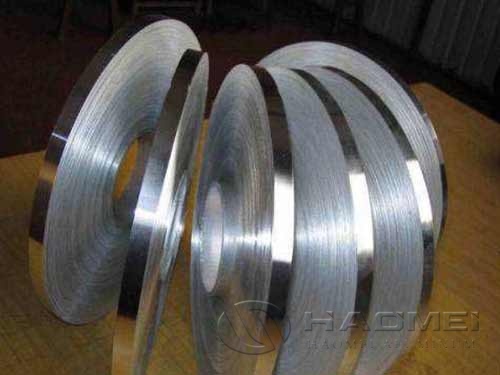
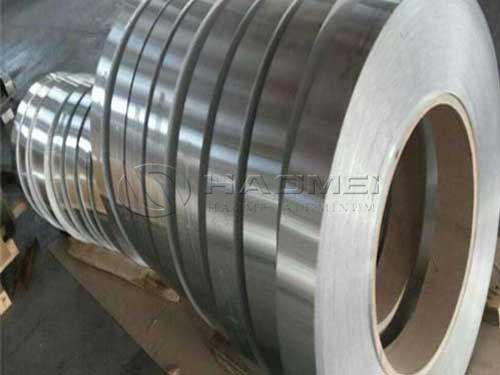
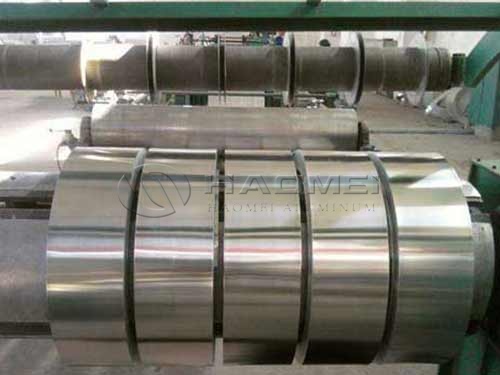
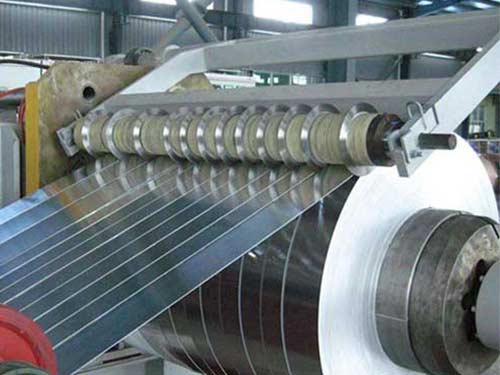
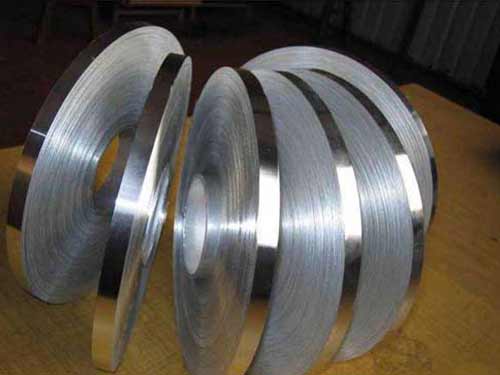
4004/3003/4004 strip aluminum plate can be supplied as slit coil, wide coil, sheet, or cut-to-length plate. Dimensions, edge condition, surface finish, and coil parameters can be matched to tube mills, stamping presses, fin-forming lines, or automated brazing systems.
| Parameter | Typical Supply Range | Notes |
|---|---|---|
| Product form | Strip coil, sheet, plate | Slit or cut-to-length service available |
| Total thickness | 0.20-3.00 mm | Heavier gauges available by agreement |
| Width | 10-1,600 mm | Narrow strip for formed tube and stamping applications |
| Coil inner diameter | 150 mm, 300 mm, 400 mm, 505 mm, 610 mm | Selected for line compatibility |
| Coil outer diameter | Up to approximately 2,000 mm | Depends on thickness and coil weight |
| Surface | Mill finish, degreased, lightly oiled | Surface condition should suit brazing preparation |
| Edge | Mill edge, slit edge, deburred edge | Burr control is important for precision forming |
| Cladding ratio | Approximately 5%-10% per side | Can be adjusted for filler-metal demand |
| Flatness and camber | According to agreed tolerance | Important for stamping and continuous forming |
Alloy Tempers and Mechanical Characteristics
Temper selection depends on the forming severity and the required stability before brazing. Softer tempers are commonly selected for deep shaping, while strain-hardened conditions can improve handling stiffness in less demanding forming operations.
| Temper | Condition | Suitable Automotive Processing |
|---|---|---|
| O | Fully annealed | Deep drawing, tube forming, corrugation, complex stamping |
| H14 | Half-hard strain hardened | General roll forming and moderate stamping |
| H16 | Three-quarter hard strain hardened | Parts needing greater pre-braze stiffness |
| H18 | Full-hard strain hardened | Limited-forming blanks and rigid strip requirements |
| H22 / H24 | Strain hardened and partially annealed | Balanced formability and handling strength |
Mechanical results vary with total gauge, cladding ratio, temper, and testing direction. The table gives general reference values for 3003-based clad material rather than a fixed acceptance guarantee.
| Property | O Temper, Typical | H14 Temper, Typical | Test Basis |
|---|---|---|---|
| Tensile strength | 95-140 MPa | 130-180 MPa | Room-temperature tensile test |
| Yield strength | 35-65 MPa | 110-160 MPa | Room-temperature tensile test |
| Elongation | 12%-25% | 3%-10% | Depends on gauge and specimen length |
| Density | Approximately 2.73 g/cm³ | Approximately 2.73 g/cm³ | Typical aluminum-alloy value |
| Thermal conductivity | Approximately 160-190 W/m·K | Approximately 160-190 W/m·K | Varies by alloy condition |
Brazing Process Considerations
4004/3003/4004 material is generally used in controlled-atmosphere brazing processes, often with nitrogen protection and a suitable non-corrosive flux. Furnace profiles must be designed around the actual component geometry, cladding thickness, flux application, and joint clearance.
The 4004 filler layer has a substantially lower melting range than the 3003 core. This difference permits filler flow while protecting the structural layer from collapse. Excessive temperature, prolonged soak time, poor cleaning, or unsuitable joint gaps can reduce brazing quality. Clean surfaces, stable coil properties, controlled lubrication, and uniform forming all contribute to consistent furnace results.
| Brazing Factor | Recommended Control Focus |
|---|---|
| Surface cleanliness | Remove excessive oil, moisture, and particles before fluxing |
| Joint clearance | Maintain consistent clearance for capillary filler flow |
| Cladding thickness | Match filler volume to the joint design |
| Furnace atmosphere | Control oxygen and moisture for stable brazing conditions |
| Heating profile | Ensure uniform temperature across the full assembly |
| Post-braze inspection | Check joint continuity, pressure resistance, distortion, and corrosion behavior |
Applicable Standards and Quality Control
Standards depend on the target market, technical drawing, and end-use approval program. Material may be supplied with dimensions and testing aligned with commonly used aluminum wrought-product standards.
| Standard or Reference | Typical Scope |
|---|---|
| ASTM B209 / B209M | Aluminum and aluminum-alloy sheet and plate requirements |
| EN 485 | Mechanical properties and tolerances for wrought aluminum products |
| EN 573 | Aluminum alloy designation and chemical composition references |
| JIS H4000 | Japanese industrial requirements for aluminum and aluminum alloy sheet, strip, and plate |
| Customer specification | Automotive dimensions, cladding ratio, brazing behavior, surface and packaging requirements |
Inspection can include composition verification, thickness measurement, width and edge inspection, cladding ratio control, tensile testing, surface examination, coil shape review, and trial-brazing evaluation. For automotive programs, material traceability from melt source through finished coil is especially valuable.
Packaging and Handling
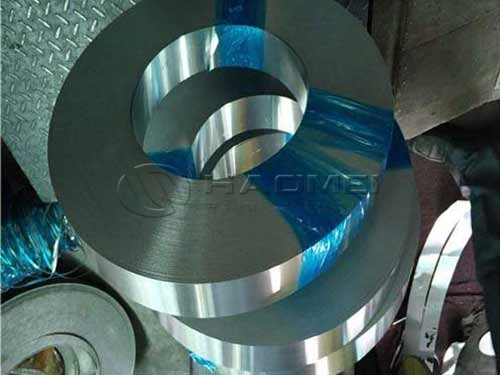
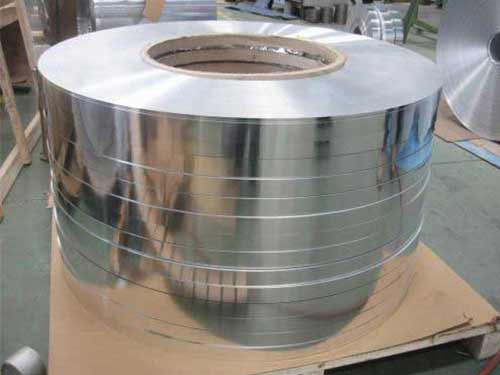
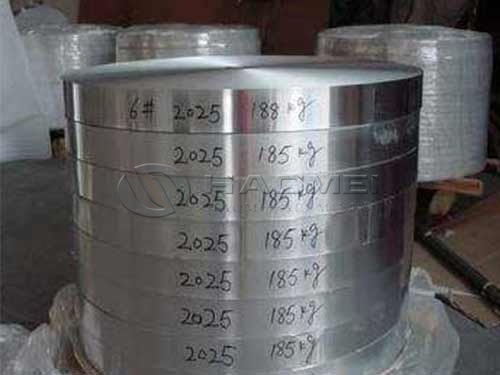
Automotive clad strip should be protected from moisture, dust, edge damage, and deformation during storage and transport. Coils are commonly wrapped with protective paper or film, secured with metal or plastic straps, and placed on reinforced pallets or wooden supports. Storage in a dry indoor environment helps preserve a brazing-ready surface.
4004/3003/4004 aluminum strip plate gives vehicle heat-exchanger producers a dependable route to lighter, efficiently brazed, and precisely formed components. With the right temper, clad ratio, tolerance package, and brazing controls, it supports high-volume production of durable automotive cooling and thermal-management systems.