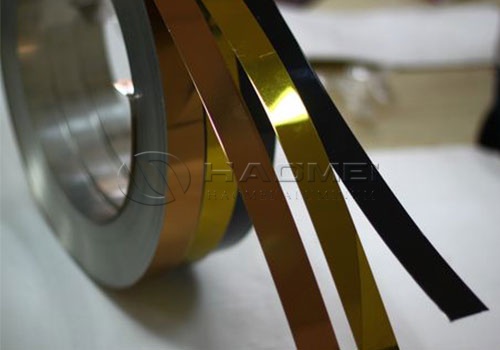
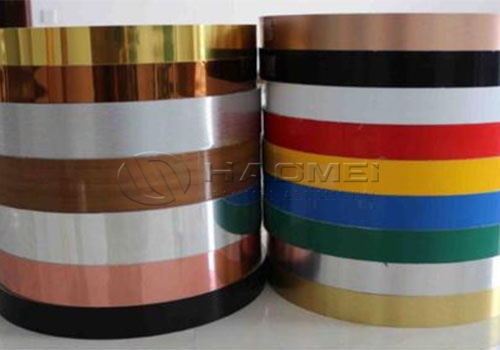
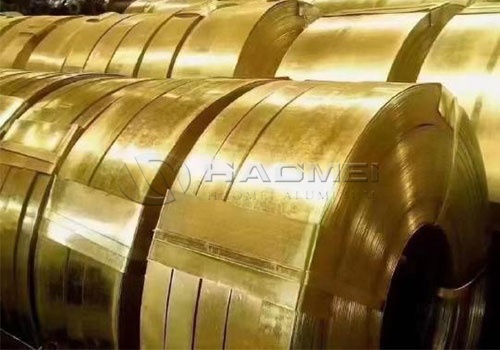
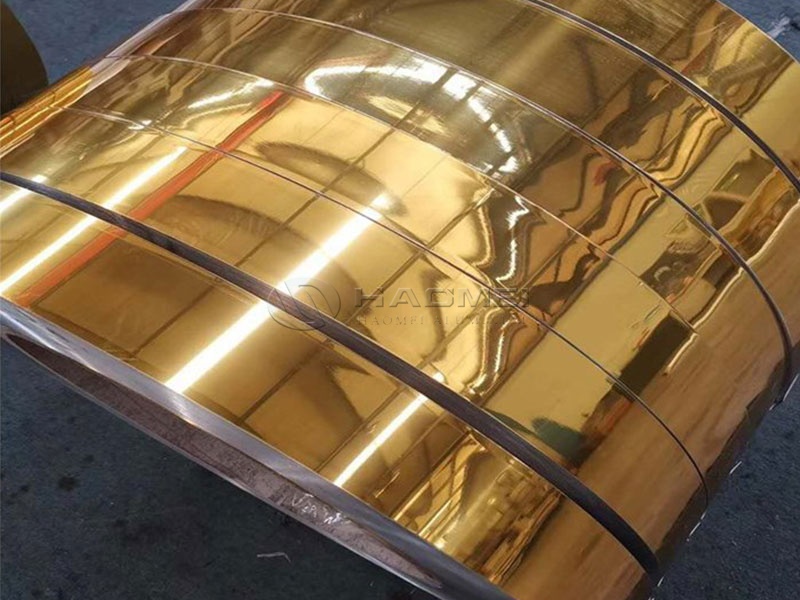
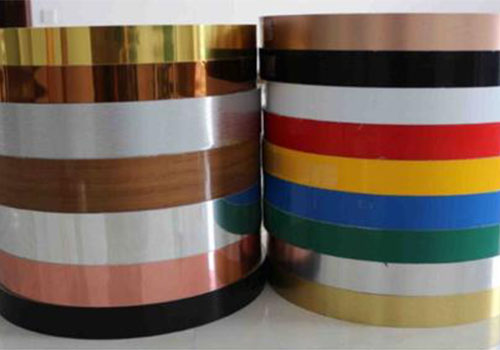
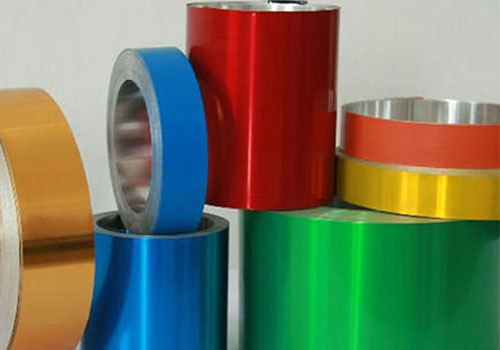
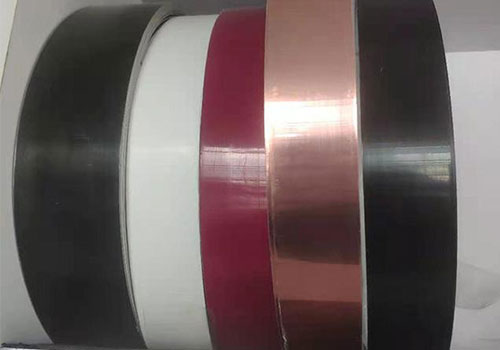
Wood Grain Colors Aluminum Strip
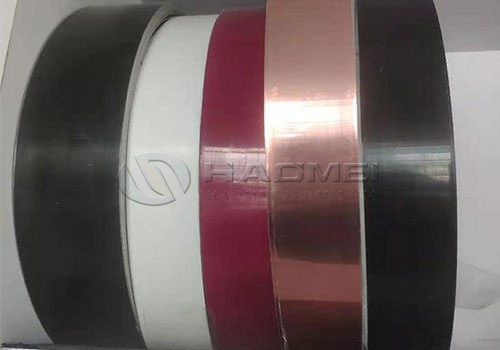
Wood Grain Colors Aluminum Strip is designed for projects that need the visual comfort of timber without accepting timber's familiar maintenance burden. It combines an aluminum substrate with a patterned coating system, producing strips that can be formed into decorative trims, ceiling panels, shutters, wall cladding, roller shutter slats, doors, and appliance components.
Its real value is not merely decorative. A wood-grain surface helps architects create warmer spaces while aluminum provides low weight, dimensional consistency, corrosion resistance, and efficient fabrication. For fabricators, the strip arrives in coil form, ready for slitting, roll forming, bending, stamping, or profiling. This makes it a practical finishing material for high-volume production as well as custom building details.
A Surface That Does More Than Imitate Wood
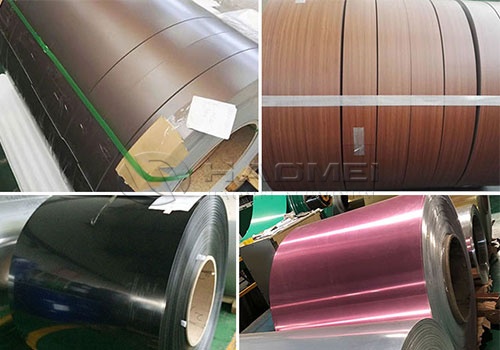
The strongest perspective on wood grain aluminum strip is to view it as a functional surface layer rather than a printed decoration. The grain pattern can visually reduce the industrial appearance of metal, while the coating film separates the substrate from moisture, airborne contaminants, fingerprints, and minor abrasion.
Wood tones such as walnut, oak, teak, cherry, rosewood, maple, and weathered timber can be matched with gloss, matte, brushed, embossed, or textured effects. The same aluminum strip can therefore support radically different design directions: dark walnut for window shutters, pale oak for interior ceilings, teak for exterior soffits, or charcoal wood grain for contemporary wall panels.
In practice, the finish is commonly created through coil coating, film lamination, thermal transfer printing, or sublimation-style pattern transfer. The chosen process affects grain depth, color repeat, weathering resistance, and forming behavior. A high-quality finish should retain a stable pattern after bending and should not show cracking, delamination, or excessive color variation along the coil.
For indoor decorative work, PE Coated Aluminum Strip is often an economical choice. For demanding exterior exposure, a fluorocarbon-based system such as PVDF Coated Aluminum Strip offers stronger resistance to ultraviolet radiation, chalking, and fading.
Where Wood Grain Aluminum Strip Performs Best
In architecture, wood grain colors aluminum strip is frequently used for fascia boards, rain-screen cladding details, pergola parts, ceiling carriers, soffits, gutter components, door frames, window blinds, and louvered systems. Aluminum is particularly suitable for long profiles because it minimizes dead weight on the supporting structure.
For ceilings and interior wall systems, the strip provides a continuous decorative appearance with less risk of warping, fungal attack, or splitting than natural wood. It is also easier to clean in public spaces such as hotels, retail stores, transport terminals, restaurants, and office corridors.
In manufacturing, the material is used in roller shutter slats, furniture edging, decorative appliance panels, lighting housings, caravan trim, and air-conditioning accessories. Narrow strips can be precisely slit for automated roll-forming lines, while wider coils can be processed into panels or composite products.
Exterior applications require careful selection. A sunny coastal façade, for example, should use an alloy and coating combination capable of resisting salt, humidity, ultraviolet exposure, and thermal cycling. A protected indoor ceiling has far less environmental demand, so thinner coatings and softer tempers can be appropriate.
Typical Material Parameters
The technical specification of wood grain aluminum strip should be selected around the forming method and service environment, not color alone. Common commercial parameters are shown here.
| Property | Common Range or Option |
|---|---|
| Aluminum alloy | 1060, 1100, 3003, 3105, 5052 |
| Temper | H12, H14, H16, H18, H22, H24, H26, H32 |
| Thickness | 0.20 mm to 1.50 mm |
| Width | 20 mm to 1,600 mm |
| Coil inner diameter | 150 mm, 300 mm, 405 mm, 505 mm, or customized |
| Coil weight | Commonly 1 to 5 tonnes, subject to handling capability |
| Front coating thickness | PE: about 18 to 25 μm; PVDF: about 25 to 35 μm |
| Back coating thickness | Usually 5 to 10 μm, or customized for bonding needs |
| Surface finish | Smooth, matte, gloss, embossed, brushed, or textured wood grain |
| Color consistency | Controlled by approved sample, color code, or project panel |
A softer temper such as H14 is helpful when the strip will undergo deep profiling, tight folding, or complex bending. H24 is often selected when a balance of stiffness and formability is needed. H18 provides higher hardness for applications requiring flatter surfaces or improved dent resistance, although it has less forming latitude.
Alloy 3003 and 3105 are commonly favored for coated architectural strip because manganese improves strength compared with pure aluminum grades while maintaining reliable workability. Alloy 5052 offers higher strength and improved corrosion resistance, making it suitable for more demanding coastal or industrial conditions. Alloy 1060 remains useful where excellent ductility and cost control are more important than structural strength.
Chemical Composition and Alloy Selection
The coating protects the visible face, but the aluminum chemistry determines how the strip behaves during rolling, forming, and long-term exposure. The table presents typical composition limits in percent by weight. Final values should follow the agreed material specification.
| Alloy | Si | Fe | Cu | Mn | Mg | Zn | Al |
|---|---|---|---|---|---|---|---|
| 1060 | 0.25 max | 0.35 max | 0.05 max | 0.03 max | 0.03 max | 0.05 max | 99.60 min |
| 1100 | Si + Fe 0.95 max | Included | 0.05 to 0.20 | 0.05 max | - | 0.10 max | 99.00 min |
| 3003 | 0.60 max | 0.70 max | 0.05 to 0.20 | 1.0 to 1.5 | - | 0.10 max | Balance |
| 3105 | 0.60 max | 0.70 max | 0.30 max | 0.30 to 0.80 | 0.20 to 0.80 | 0.40 max | Balance |
| 5052 | 0.25 max | 0.40 max | 0.10 max | 0.10 max | 2.2 to 2.8 | 0.10 max | Balance |
The manganese in 3003 and 3105 contributes to strength and form stability. Magnesium in 5052 improves strength and marine-atmosphere performance. Pure aluminum grades such as 1060 and 1100 retain excellent conductivity and ductility, though they are generally less rigid than manganese- or magnesium-bearing alloys.
Standards and Quality Control Conditions
Wood grain colors aluminum strip can be supplied according to EN 1396 for coil-coated aluminum sheet and strip, EN 485 requirements for aluminum wrought products, ASTM B209 for aluminum sheet and strip, or GB/T 3880 where required by the project. Coating performance may also be assessed through ISO test methods for adhesion, gloss, hardness, impact resistance, and salt-spray exposure.
Useful quality checks include coating thickness measurement, pencil hardness, cross-cut adhesion, T-bend resistance, gloss control, color comparison, solvent resistance, and visual inspection under standardized lighting. For exterior projects, buyers should define acceptable color variation, coating type, film thickness, corrosion test expectations, and the intended service location before production.
The most dependable wood grain finish is one that is specified as a complete system: alloy, temper, pretreatment, primer, topcoat or transfer film, thickness, gloss level, and forming requirement. When these details work together, wood grain aluminum strip becomes a durable design material rather than a short-lived decorative substitute.