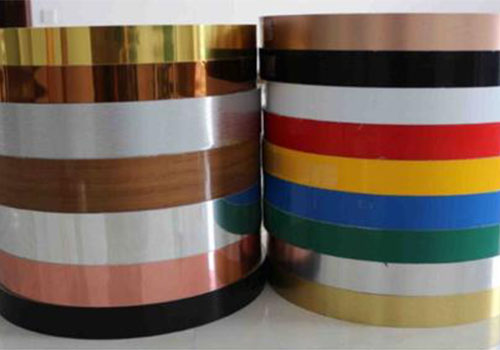
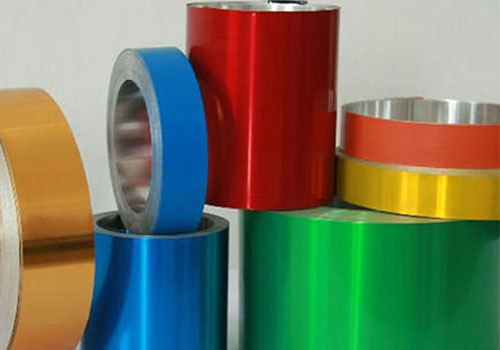
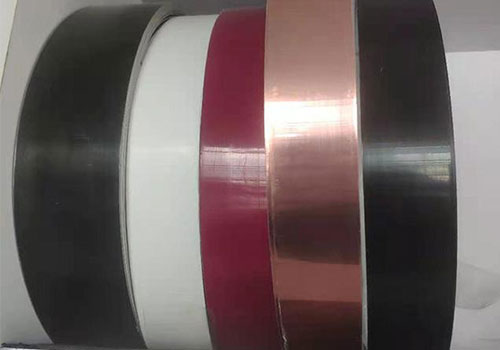
Color Coated Aluminum Foil Strip
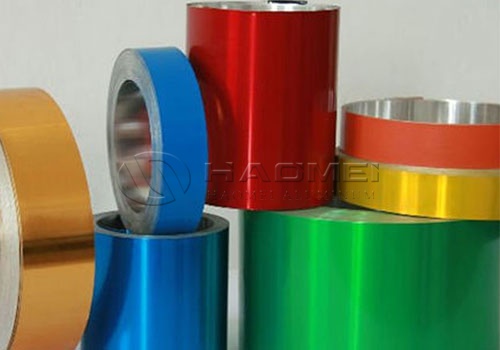
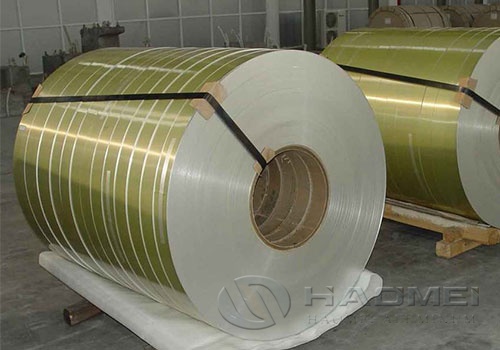
Color coated aluminum foil strip is often judged by its surface first: red, gold, green, matte white, metallic silver, or a custom RAL shade. Yet the real value sits under the color. It is a thin, slit aluminum base protected by a controlled coating layer, designed to bend, wrap, seal, decorate, insulate, identify, or shield without losing its clean appearance.
For purchasing teams, the product is best understood as a small coil with three working layers: the aluminum core, the pretreatment film, and the organic coating. Each layer decides how the strip behaves on a production line. The aluminum gives formability and conductivity, the pretreatment improves adhesion and corrosion resistance, and the coating supplies color, gloss, barrier performance, and weatherability.
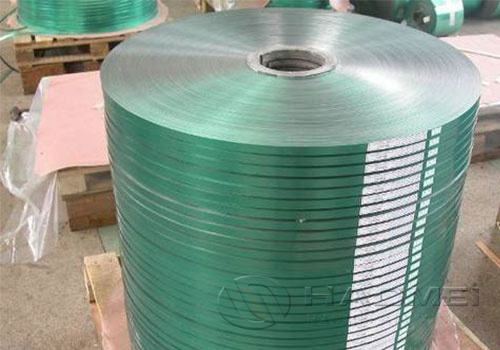
What Makes Foil Strip Different From Ordinary Painted Strip
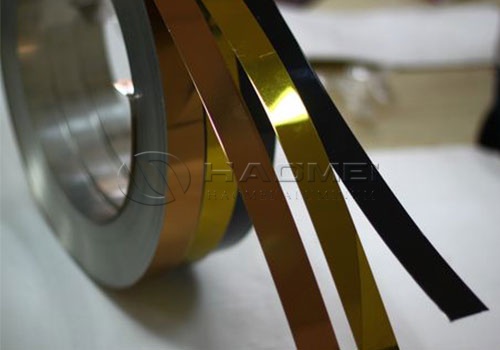
Color coated aluminum foil strip normally refers to thinner gauges than standard architectural coated coil. Thickness may start near 0.02 mm and extend to around 0.50 mm, depending on the application. The narrow width, soft temper options, and high surface demand make it suitable for bottle caps, cable wrapping, blinds, heat exchanger fins, labels, flexible packaging, transformer insulation, decorative edge banding, and lightweight craft or industrial parts.
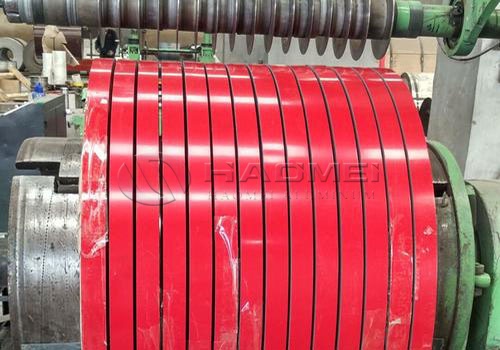
The strip is not simply painted metal. A reliable Coated Aluminum Strip is produced through degreasing, chemical conversion, primer or back coat application, color coating, curing, cooling, inspection, and precision slitting. When the foil is very thin, tension control becomes critical. Too much tension may stretch the foil; too little can cause wrinkles, coating marks, or poor winding.
Common Product Parameters
| Item | Typical Range or Option |
|---|---|
| Aluminum alloy | 1050, 1060, 1070, 1100, 3003, 3004, 5052, 8011, 8079 |
| Temper | O, H12, H14, H16, H18, H19, H22, H24, H26 |
| Thickness | 0.02 mm to 0.50 mm |
| Width after slitting | 5 mm to 600 mm, customized by order |
| Coil inner diameter | 76 mm, 150 mm, 300 mm, 405 mm, 508 mm |
| Coating type | PE, polyester, epoxy, acrylic, polyurethane, PVDF for demanding outdoor service |
| Coating thickness | 3 um to 25 um per side, based on use |
| Surface finish | Glossy, matte, embossed, smooth, brushed effect, metallic color |
| Color system | RAL, Pantone, customer sample matching |
| Protective film | Optional for scratch-sensitive surfaces |
| Edge condition | Slit edge, deburred edge on request |
A thin foil strip can look simple, but tolerance control is strict. For cap stock, thickness uniformity affects forming pressure and sealing performance. For cable foil, pinhole level and tensile strength influence shielding stability. For decorative trim, color difference and edge quality may matter more than mechanical strength.
Alloy and Temper Selection
Soft O temper is preferred when deep bending, wrapping, folding, or sealing is required. H14 and H16 provide a balance between workability and strength. H18 and H19 are harder tempers used where dimensional stability and spring resistance are important. For foil gauges, even a small temper change can alter how the strip feeds through automatic equipment.
Pure aluminum grades such as 1050, 1060, 1070, and 1100 offer excellent formability, thermal conductivity, and corrosion resistance. They are often selected for packaging, labels, insulation, and decorative foil strip. 3003 and 3004 contain manganese, giving better strength while retaining good workability. 5052 brings magnesium-based strength and improved marine or humid-environment resistance. 8011 and 8079 are widely used in foil applications because they offer dependable rolling performance, barrier behavior, and stable mechanical properties.
For buyers choosing between coating systems, PE Coated Aluminum Strip is practical for indoor decoration, packaging, and general industrial use. PVDF coating is more suitable when ultraviolet resistance, outdoor color retention, and chemical resistance are demanded.
Chemical Composition Reference
The chemical properties of the aluminum base follow alloy standards. Values may vary slightly by production standard and customer specification, but the table gives common reference limits in percent by weight.
| Alloy | Si | Fe | Cu | Mn | Mg | Cr | Zn | Ti | Al |
|---|---|---|---|---|---|---|---|---|---|
| 1050 | 0.25 max | 0.40 max | 0.05 max | 0.05 max | 0.05 max | - | 0.05 max | 0.03 max | 99.50 min |
| 1060 | 0.25 max | 0.35 max | 0.05 max | 0.03 max | 0.03 max | - | 0.05 max | 0.03 max | 99.60 min |
| 1100 | Si+Fe 0.95 max | Si+Fe 0.95 max | 0.05-0.20 | 0.05 max | - | - | 0.10 max | - | 99.00 min |
| 3003 | 0.60 max | 0.70 max | 0.05-0.20 | 1.00-1.50 | - | - | 0.10 max | - | Balance |
| 3004 | 0.30 max | 0.70 max | 0.25 max | 1.00-1.50 | 0.80-1.30 | - | 0.25 max | - | Balance |
| 5052 | 0.25 max | 0.40 max | 0.10 max | 0.10 max | 2.20-2.80 | 0.15-0.35 | 0.10 max | - | Balance |
| 8011 | 0.50-0.90 | 0.60-1.00 | 0.10 max | 0.20 max | 0.05 max | 0.10 max | 0.10 max | 0.08 max | Balance |
| 8079 | 0.05-0.30 | 0.70-1.30 | 0.05 max | 0.10 max | 0.05 max | - | 0.10 max | - | Balance |
These elements are not only numbers in a mill certificate. Iron and silicon affect rolling texture and strength. Manganese improves mechanical stability. Magnesium raises strength and corrosion resistance. High aluminum purity supports excellent conductivity and easy forming. When coating is applied, the alloy must also survive cleaning, pretreatment, curing temperature, and slitting without surface defects.
Standards and Testing Conditions
Color coated aluminum foil strip can be supplied according to commonly recognized standards such as ASTM B209, EN 485, EN 573, EN 546 for aluminum foil, GB/T 3198, GB/T 3880, JIS H4000, and ISO-related coating test methods. Coating performance may be checked through ASTM D3359 for adhesion, ASTM D523 for gloss, ASTM D2244 for color difference, ASTM B117 for salt spray resistance, and T-bend or pencil hardness testing according to project requirements.
Typical inspection conditions include controlled light source color matching, dry film thickness measurement, surface cleanliness testing, and coil winding inspection. For demanding supply contracts, customers may request reports for tensile strength, elongation, coating adhesion, solvent resistance, boiling water resistance, salt spray hours, and RoHS or REACH compliance.
Coating Performance in Real Use
A coated foil strip succeeds when it performs quietly during processing. It should unwind smoothly, pass through rollers without powdering, bend without cracking, and keep color from batch to batch. For packaging, food-contact suitability or odor control may be required. For heat transfer parts, coating thickness must be managed so thermal performance is not unnecessarily reduced. For cable wrapping, the coating should not interfere with shielding or bonding layers.
Color difference is usually controlled by Delta E values agreed between buyer and supplier. Gloss may be high for decorative products or low for anti-glare surfaces. Adhesion is commonly tested by cross-cut or bend methods. In many applications, the best coating is not the thickest one, but the coating that matches the forming radius, exposure environment, and line speed.
Ordering Details That Prevent Problems
A clear inquiry should state alloy, temper, thickness, width, coating type, color code, gloss, inner diameter, outer diameter or coil weight, application, surface requirement, and standard. If the strip will be stamped, rolled, folded, heat sealed, laminated, or exposed outdoors, that condition should be shared before production. Small details such as burr direction, winding direction, paper interleaving, and protective film can affect efficiency on automatic equipment.
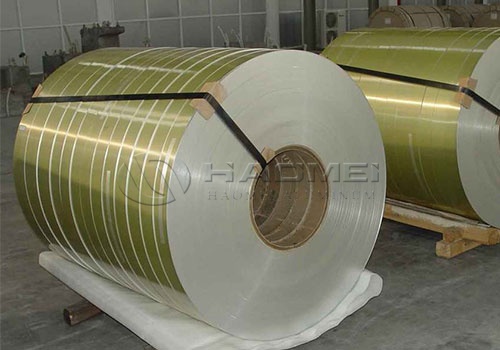
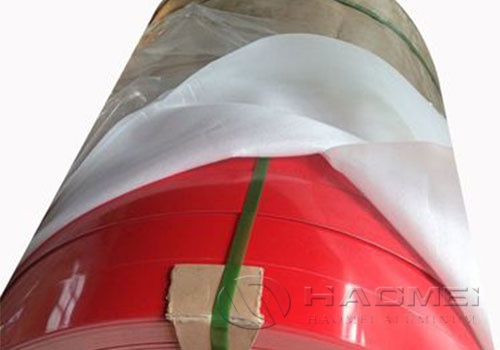
For export packing, coils are commonly wrapped with moisture-proof paper, plastic film, edge protection, and wooden pallets or cases. Thin foil strip should be protected from impact, water vapor, and pressure marks. Storage in a dry room helps avoid oxidation, coating stain, and telescoping caused by temperature changes.
A Practical Way to Choose
Start with the function, then choose the alloy and coating. If the strip must wrap tightly, choose a soft temper with excellent elongation. If it must hold shape, move toward harder tempers. If the environment is indoor and cost sensitive, PE or polyester coating is often enough. If sun, rain, salt, or industrial air are present, PVDF or higher-performance coating should be considered.
Color coated aluminum foil strip is a compact material with a wide working range. It gives designers color, manufacturers speed, and buyers a strong balance of weight, corrosion resistance, and visual quality. When alloy, temper, coating, tolerance, and test standards are aligned from the beginning, the strip becomes more than colored foil; it becomes a dependable part of the finished product.