Color Coated Strip Sheet
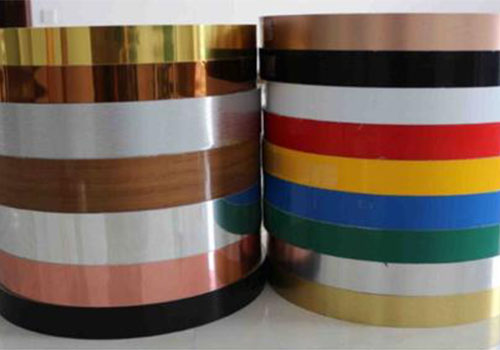
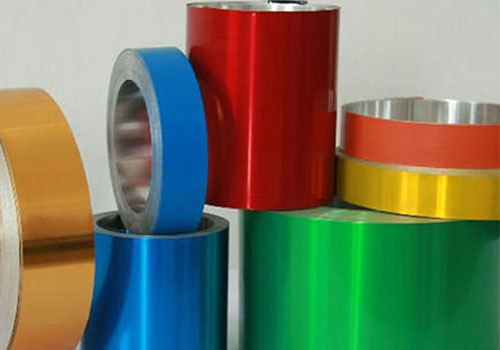
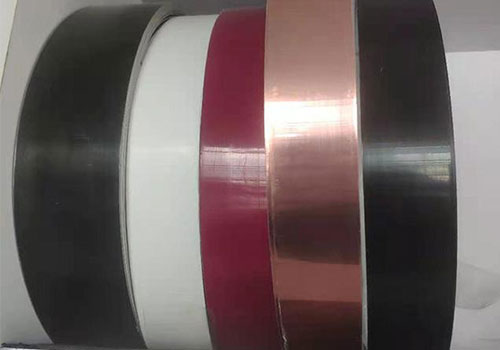
Color coated strip sheet is more than metal with paint. It is a pre-engineered surface system: aluminum substrate, pretreatment film, primer, color coating, and optional back coat working together before the material reaches a forming line. For customers, this means less post-painting work, faster production, stable color batches, and reliable corrosion resistance in demanding indoor and outdoor environments.
In practical use, the product behaves like a ready-made building skin or decorative component. It can be slit into narrow coils, cut into sheets, roll-formed into panels, stamped into caps, bent into ceiling strips, or laminated into composite structures. The value is not only in appearance, but also in how consistently it performs during forming, installation, weather exposure, and long-term cleaning.
What the Coating Really Does
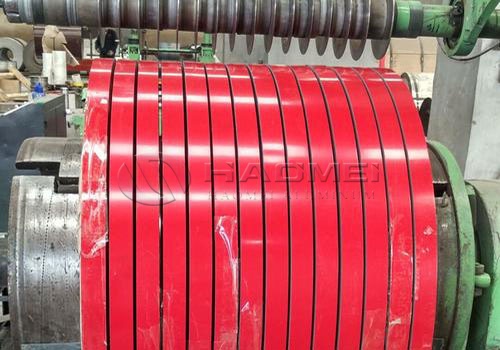
The coating on a color coated strip sheet has several functions at the same time. It gives the surface a controlled color and gloss, protects aluminum from staining and aggressive atmospheres, improves resistance to ultraviolet light, and provides a cleanable finish. In many products, it also reduces fabrication cost because cutting, bending, and punching can be done after coating without requiring a separate painting process.
The metal substrate supplies strength, flatness, ductility, and thermal stability. The coating supplies surface performance. When both are matched correctly, the strip can pass through roll forming, lock seaming, bending, and stamping with minimal cracking or peeling.
For customers selecting a Color Coated Aluminum Strip, the coating type should be chosen according to the exposure condition. PE coating is widely used for indoor decoration, ceilings, lighting parts, and general panels. PVDF coating is preferred for exterior facades, roofing, curtain wall panels, and areas with stronger sunlight or industrial atmosphere.
Common Product Parameters
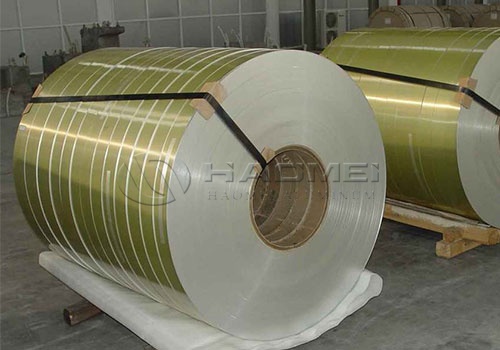
Typical color coated strip sheet is supplied in coil, strip, or flat sheet form. Thickness, width, coating thickness, and mechanical condition can be customized to suit production equipment and finished part requirements.
| Item | Common Range or Requirement |
|---|---|
| Base metal | Aluminum and aluminum alloy strip or sheet |
| Alloy grades | 1050, 1060, 1100, 3003, 3004, 3105, 5005, 5052 |
| Temper | O, H12, H14, H16, H18, H22, H24, H26, H32, H34 |
| Thickness | 0.18 mm to 3.00 mm, depending on application |
| Strip width | 20 mm to 1600 mm, narrow slit coil available |
| Sheet width | Commonly up to 1600 mm or as required |
| Coating type | PE, HDP, SMP, PVDF, epoxy back coat |
| Top coating thickness | PE: 16-25 microns; PVDF: 25-35 microns typical |
| Back coating thickness | 5-15 microns typical |
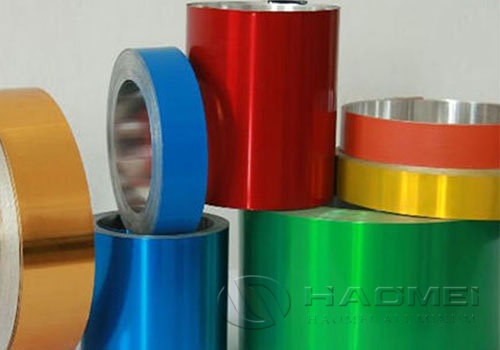
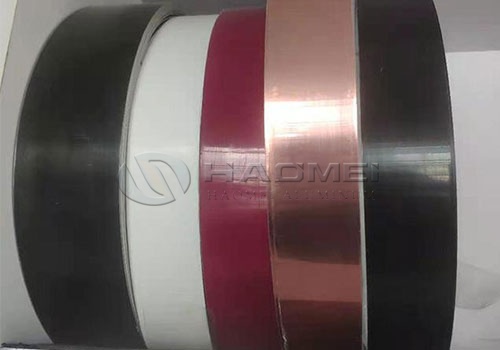
| Gloss | Matte, semi-gloss, high gloss, customized |
| Color system | RAL, Pantone, customer sample matching |
| Surface texture | Smooth, embossed, wood grain, stone pattern, brushed effect |
| Protective film | Optional, peelable film for fabrication protection |
Standards Used in Production and Inspection
Color coated strip sheet is usually produced and tested according to aluminum substrate standards and coating performance standards. Common references include ASTM B209 for aluminum sheet and plate, EN 485 for aluminum sheet, strip, and plate, EN 1396 for coil coated aluminum, GB/T 3880 for aluminum alloy plates and strips, and JIS H4000 for aluminum sheets and strips.
For coating durability, frequently used methods include ASTM D3359 for adhesion, ASTM D523 for gloss, ASTM D3363 for pencil hardness, ASTM D2794 for impact resistance, ASTM B117 for salt spray testing, and AAMA 2603, AAMA 2604, or AAMA 2605 for architectural coating performance levels. Exterior building products often require stricter coating systems, especially when color retention and chalking resistance are important.
Alloy and Temper Selection
Alloy and temper control how the material behaves during processing. Soft tempers such as O and H12 are easier to deep draw or bend. H14 and H24 provide balanced strength and formability. H18 is harder and flatter, suitable for applications where rigidity matters more than severe forming.
Pure aluminum grades such as 1050 and 1060 offer excellent formability, high reflectivity, and strong corrosion resistance. They are often used for decorative strips, lighting, bottle caps, heat insulation facings, and general indoor components. 1100 provides similar benefits with reliable workability.
3003, 3004, and 3105 add manganese and sometimes magnesium, improving strength while maintaining good corrosion resistance. These grades are popular for roofing, gutters, roller shutters, ceiling systems, composite panels, and curtain wall decoration. 5005 and 5052 contain magnesium, giving better strength and marine atmosphere resistance, making them suitable for outdoor signs, transport parts, and equipment housings.
| Alloy | Typical Temper | Main Character | Common Uses |
|---|---|---|---|
| 1050 / 1060 | O, H12, H14, H18 | Very high formability and corrosion resistance | Decoration, lighting, caps, insulation facings |
| 1100 | O, H14, H16 | Good ductility and stable surface quality | Panels, labels, general fabrication |
| 3003 | H14, H24, H26 | Better strength than pure aluminum | Roofing, ceilings, gutters, blinds |
| 3004 / 3105 | H24, H26, H28 | Higher strength and good coating response | Building panels, shutters, wall systems |
| 5005 | H32, H34 | Good anodizing and coating appearance | Architectural decoration, signs |
| 5052 | H32, H34 | Stronger corrosion resistance and strength | Marine trim, transport panels, equipment shells |
Chemical Composition Reference
The chemical composition of the aluminum substrate influences strength, corrosion resistance, bending behavior, and coating response. Values vary by standard and mill certificate, but typical limits are shown here for common grades.
| Alloy | Si | Fe | Cu | Mn | Mg | Zn | Al |
|---|---|---|---|---|---|---|---|
| 1050 | 0.25 max | 0.40 max | 0.05 max | 0.05 max | 0.05 max | 0.05 max | 99.50 min |
| 1060 | 0.25 max | 0.35 max | 0.05 max | 0.03 max | 0.03 max | 0.05 max | 99.60 min |
| 1100 | Si+Fe 0.95 max | Si+Fe 0.95 max | 0.05-0.20 | 0.05 max | - | 0.10 max | 99.00 min |
| 3003 | 0.60 max | 0.70 max | 0.05-0.20 | 1.00-1.50 | - | 0.10 max | Balance |
| 3004 | 0.30 max | 0.70 max | 0.25 max | 1.00-1.50 | 0.80-1.30 | 0.25 max | Balance |
| 3105 | 0.60 max | 0.70 max | 0.30 max | 0.30-0.80 | 0.20-0.80 | 0.40 max | Balance |
| 5005 | 0.30 max | 0.70 max | 0.20 max | 0.20 max | 0.50-1.10 | 0.25 max | Balance |
| 5052 | 0.25 max | 0.40 max | 0.10 max | 0.10 max | 2.20-2.80 | 0.10 max | Balance |
For coating chemistry, PE coatings are based on polyester resin systems and provide economical color stability for mild exposure. PVDF coatings use polyvinylidene fluoride resin, usually with high fluorocarbon resin content, giving better UV resistance, chalking resistance, and outdoor color retention. Primer chemistry often includes epoxy or polyurethane systems to improve adhesion between pretreatment and top coat.
Applications Seen Through Fabrication Behavior
In roofing and wall cladding, color coated strip sheet must resist sunlight, rain, thermal cycling, and edge corrosion. PVDF or high-durability polyester systems are commonly selected. The alloy is often 3003, 3004, or 3105 in H24 or H26 temper, giving enough strength for panel stiffness while still allowing roll forming.
In ceiling strips, lighting channels, decorative trims, and Venetian blinds, the material is judged by surface consistency, bendability, color accuracy, and edge quality. PE coated aluminum strip is frequently suitable because indoor exposure is moderate and cost efficiency matters. For projects needing a controlled finish, Coated Aluminum Strip can be slit to the exact width required by automated forming lines.
In signage, advertising panels, home appliance shells, and transport interiors, color coated strip sheet reduces finishing steps. The surface is already decorative, so the fabricator can focus on cutting, punching, grooving, and assembly. For exterior signs, 5005 or 5052 with PVDF coating can improve durability in polluted or coastal areas.
Performance Checks Customers Should Notice
A good color coated strip sheet should show uniform color, smooth paint flow, stable gloss, tight adhesion, and clean edges after slitting. During bending, the coating should not crack at the outer radius under the specified T-bend condition. During impact testing, the film should remain attached without flaking. Salt spray performance depends on alloy, coating thickness, pretreatment, and edge protection, so it should be matched to the final environment rather than selected only by price.
Packaging also matters. Coils should be protected against moisture, abrasion, and telescoping. Sheets should be separated or filmed when the surface is highly decorative. Storage in a dry, ventilated warehouse helps prevent condensation marks before fabrication.
How to Specify the Product Clearly
A clear purchase request should include alloy, temper, thickness, width, coating type, color code, gloss, top and back coating thickness, surface finish, tolerance, coil inner diameter, order weight, application, and required standard. If the part will be sharply bent or roll formed, the bending radius and forming method should be shared in advance. If it will be installed outdoors, expected service environment and durability requirement should guide the coating choice.
Color coated strip sheet works best when selected as a complete system rather than as only a painted metal. The right combination of substrate, temper, pretreatment, coating resin, film thickness, and inspection standard can make production smoother and finished products more durable, attractive, and cost-effective.